





















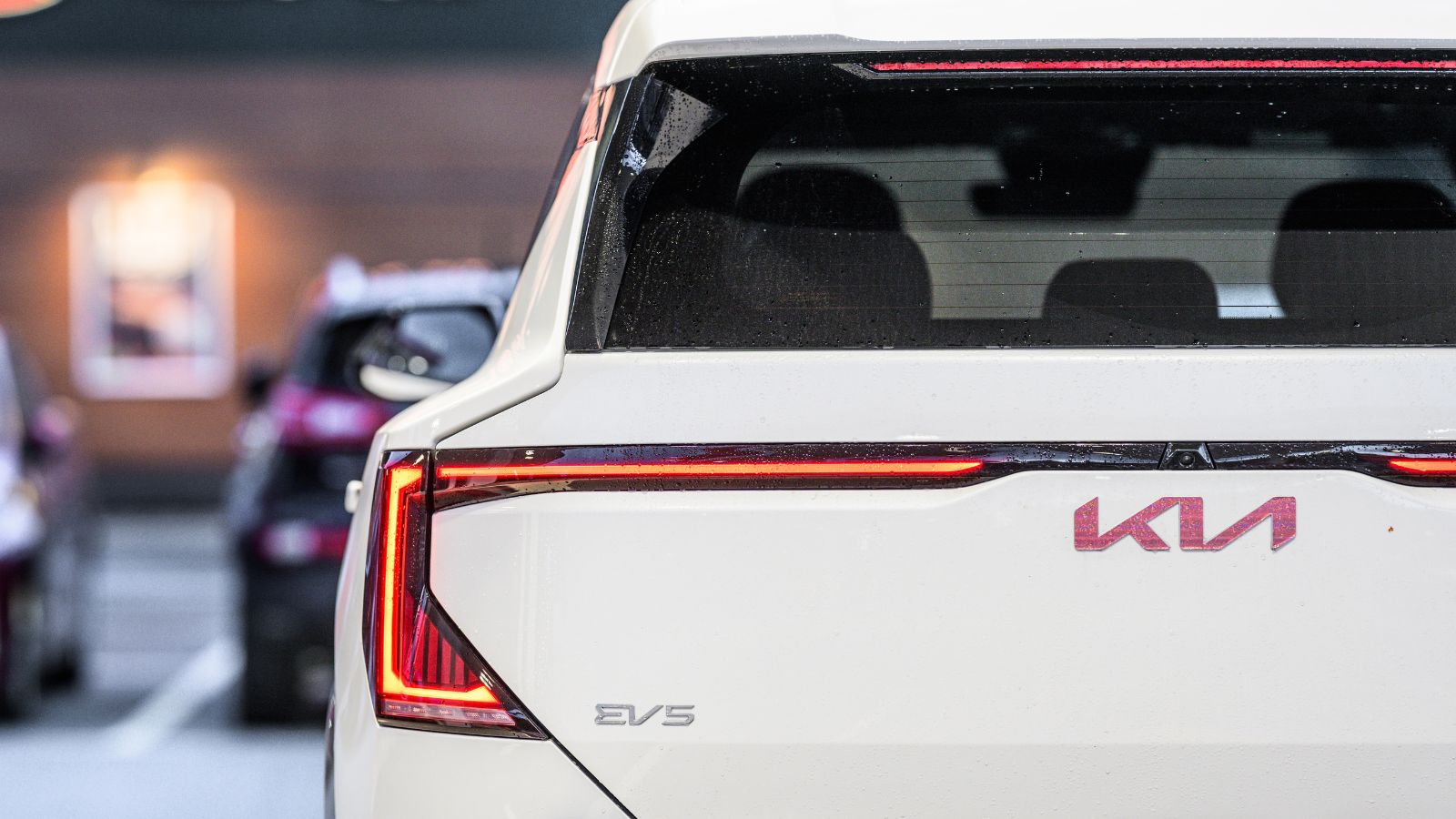
Kia’s newest electric family SUV has reached Canadian streets with an unusual distinction: in North America, the EV5 is officially a Canada-only product. That makes its first real-world tests especially interesting, because the compact electric SUV Canadians can now buy remains unavailable to shoppers just across the U.S. border.
A week with a 2027 Kia EV5 Land FWD around Vancouver provided a useful reality check. Rather than behaving like an electric performance showcase, the EV5 emerged as a comfortable, spacious and relatively conventional family vehicle. Its Vancouver test also exposed compromises—from numb steering to missing premium features—that matter once the price climbs above $50,000. The result is less spectacular than revolutionary, but perhaps more relevant to everyday EV shoppers.
Canada’s EV5 Exclusivity Is More Unusual Than It Sounds
The EV5 is not literally exclusive to Canada worldwide. Kia sells or plans to sell the model in several international markets. What makes the Canadian version unusual is Kia’s explicit decision to make Canada the EV5’s only North American market. The company has repeatedly described it as “exclusive to Canada for the North American market,” and Canadian production is sourced from Kia’s Autoland Gwangju plant in South Korea.
That decision gives Canadian dealerships a family-sized electric SUV that American Kia stores cannot offer. It also reverses the usual assumption that Canada simply receives whatever is approved for the much larger U.S. market. The EV5 entered Canada because Kia saw an opportunity in the country’s enormously important compact-SUV segment. Nine configurations were announced, ranging from an eventual $43,495 Light FWD to a $61,495 GT-Line Limited AWD before freight, taxes and other charges. In this case, Canada is not an afterthought—it is the North American target market.
Vancouver Shows What the EV5 Is Actually Built to Do
The Vancouver test involved an EV5 Land FWD used for a week of ordinary driving rather than a carefully controlled launch event. It handled commuting, stop-and-go urban traffic, highway stretches, a trip into the nearby mountains and even transportation to a birthday dinner. That mix matters because it resembles the life many buyers expect an electric crossover to handle without special planning.
The verdict was strikingly normal. The EV5 was praised for cabin isolation, ride comfort and straightforward operation rather than neck-snapping acceleration or exotic technology. That is arguably the model’s real mission. The Land FWD has a 215-horsepower front motor and 218 lb-ft of torque, figures that are adequate rather than extraordinary in today’s EV market. Around Vancouver, the powertrain reportedly provided painless merging and overtaking. Its accelerator was easy to modulate, while strong regenerative braking worked particularly well in congestion. The EV5 feels designed around daily usefulness rather than performance theatre.
The Price Sweet Spot Is Not the Cheapest EV5
Kia advertises a starting MSRP of $43,495 for the Light FWD, but there is an important catch: that entry model is scheduled for the fourth quarter of 2026. It also uses a smaller 60.4-kWh battery with a targeted 335-kilometre range. Buyers shopping today are therefore more likely to encounter the better-equipped versions using Kia’s 81.4-kWh long-range battery.
The Vancouver-tested Land FWD carries a $49,995 base MSRP. With freight, air-conditioning tax and its optional paint, the reviewed vehicle reached $52,495 before sales tax. That buys the long-range battery, heat pump, synthetic-leather seating, panoramic sunroof, 19-inch wheels, smart power liftgate and vehicle-to-load capability. The less expensive Wind FWD starts at $47,495 and retains the large battery and heat pump, making it potentially one of the lineup’s strongest value choices. Kia has created a broad pricing ladder, but the version advertised at $43,495 does not represent the specification most early customers will actually experience.
Range May Be the EV5’s Strongest Everyday Argument
Long-range front-wheel-drive EV5 models are targeted at approximately 460 kilometres of driving range, while adding all-wheel drive reduces the figure to roughly 410 to 415 kilometres depending on trim. That difference creates an interesting Canadian decision: buyers can choose additional winter traction or preserve roughly 45 to 50 kilometres of rated range and save several thousand dollars.
During the Vancouver test, the dashboard at one point predicted just under 500 kilometres after a full charge. That was an estimated range generated under favourable summer driving conditions, not an independently measured 500-kilometre test result, so it should not be confused with Kia’s official target. More important was how little battery management dominated the week. The vehicle handled urban driving, highway use and a mountain outing without creating persistent range anxiety. For a family crossover, that may be more meaningful than a spectacular laboratory number. An EV becomes easier to accept when drivers stop organizing ordinary days around its battery percentage.
Charging Is Competitive, but This Is No EV6
Every Canadian EV5 receives a native North American Charging Standard port, giving the vehicle compatibility with the charging connector increasingly used across the continent. Kia says DC fast charging can take the battery from approximately 10 per cent to 80 per cent in about 30 minutes under appropriate conditions. That is respectable for the segment, even if it lacks the exceptionally rapid 800-volt charging architecture associated with vehicles such as Kia’s EV6.
The Vancouver experience reinforced that distinction. Most meaningful charging during the week was accomplished overnight on a Level 2 charger in an underground parking garage. A separate public Level 2 session during a hike added only a modest amount of indicated range. For commuters who can recharge at home, the EV5’s charging speed may seldom become a major concern. Drivers repeatedly covering very long distances will notice the difference more. The EV5 is clearly optimized to make regional travel easy, not to win charging-station stopwatch contests on transcontinental journeys.
Front-Wheel Drive Works—Until the Road Gets Interesting
There is a good financial and efficiency case for the front-wheel-drive EV5, particularly around Vancouver. The single-motor Land delivers enough power for daily traffic, costs less than its AWD equivalent and preserves additional range. The test vehicle also proved comfortable over rough pavement, stable on the highway and impressively quiet. Those qualities are arguably more useful in a family SUV than razor-sharp cornering responses.
Push harder, however, and limitations emerge. The review reported some torque steer through the wheel, very light steering with limited feedback and noticeable body roll. Sport mode mainly changed accelerator response rather than transforming the chassis. None of that makes the EV5 unsafe or unpleasant; it simply establishes its priorities. For drivers making frequent winter runs toward Whistler or crossing mountain highways such as the Coquihalla, Kia’s AWD option may still justify its higher purchase price and range penalty. For mostly urban Lower Mainland use with proper winter tires, the Vancouver experience suggests FWD is a credible alternative.
The Boxy Shape Pays Off Where Families Notice It
The EV5 borrows part of its visual language from the larger EV9, with an upright profile and squared-off proportions that distinguish it from more rounded compact crossovers. Those dimensions are not merely styling choices. The tall roof and relatively conventional SUV shape translate into substantial passenger and cargo space, helping the vehicle feel larger inside than its exterior footprint initially suggests.
Kia also made several practical packaging decisions. Moving the gear selector to the steering column frees storage space around the centre console. The rear seats can fold completely flat, and there is a small front storage compartment suitable for charging equipment and other items. The Vancouver review measured the practical effect at roughly 965 litres of cargo room behind the second row and more than 2,000 litres with those seats folded. An approximately 44-litre front trunk provides additional flexibility. In an EV category often marketed around software and acceleration, the EV5’s strongest trick may simply be making very efficient use of a rectangular body.
The Cabin Feels Expensive Until the Equipment List Is Examined
Inside, Kia has avoided several interface choices that have frustrated buyers of screen-heavy vehicles. The EV5 combines two 12.3-inch displays with wireless Apple CarPlay and Android Auto while retaining physical controls for important climate functions. The Vancouver test praised the graphics, straightforward infotainment layout and overall presentation, with synthetic leather in the Land trim appearing more convincing than its non-luxury positioning might suggest.
Yet the $52,495 as-tested price exposes some feature compromises. The Land FWD does not include ventilated front seats, which Kia reserves for GT-Line versions, and it lacks the surround-view camera available farther up the range. The wireless phone charger was also criticized for being slower than expected. None of those omissions fundamentally damages the vehicle, but expectations change above $50,000. Canadian buyers are no longer evaluating an inexpensive entry-level EV at that point. They are comparing a well-equipped electric family SUV against increasingly competitive alternatives, and seemingly small equipment differences can become meaningful.
The American Question Still Has No Simple Official Answer
Kia has made the geographic outcome clear but has not publicly attributed the EV5’s U.S. exclusion to one single policy or commercial factor. Earlier reporting connected the decision to manufacturing and incentive complications, while later changes to American tariff and EV policy have only made the economics of imported electric vehicles more complicated. The Canadian EV5 being built in South Korea adds another distinction from several locally produced U.S.-market electric vehicles.
That means claims that one specific tariff “killed” the American EV5 go further than Kia itself has gone. What can be stated confidently is that the company continues to describe the model as Canadian-exclusive within North America. EV5 prototypes spotted in the United States have occasionally generated speculation about a policy reversal, but no U.S. retail launch has been announced. The consequence is straightforward: Americans searching for a practical Kia EV between smaller and more expensive offerings have one fewer choice, even while Canadians can walk into dealerships and order one.
Its Lack of Drama May Be Exactly Why the EV5 Matters
The Vancouver test ultimately rated the Land FWD highly despite several dynamic weaknesses. The steering was not especially communicative, body control did not invite aggressive driving, and the model lacked a few desirable features. At the same time, it was quiet, spacious, comfortable, straightforward to operate and capable of completing a varied week without turning charging or range into a constant concern.
That combination illustrates why the EV5 could matter more than its specifications initially suggest. Mass-market electrification eventually depends less on convincing enthusiasts to buy technologically spectacular vehicles and more on giving ordinary households electric versions of vehicles they already understand. The EV5 looks and behaves like a conventional family crossover whose power happens to come from a battery. Around Vancouver, that formula largely worked. The unusual part is geographical rather than mechanical: Canadians get to decide whether that sensible approach is worth their money, while U.S. Kia shoppers, at least for now, do not get the same choice.